
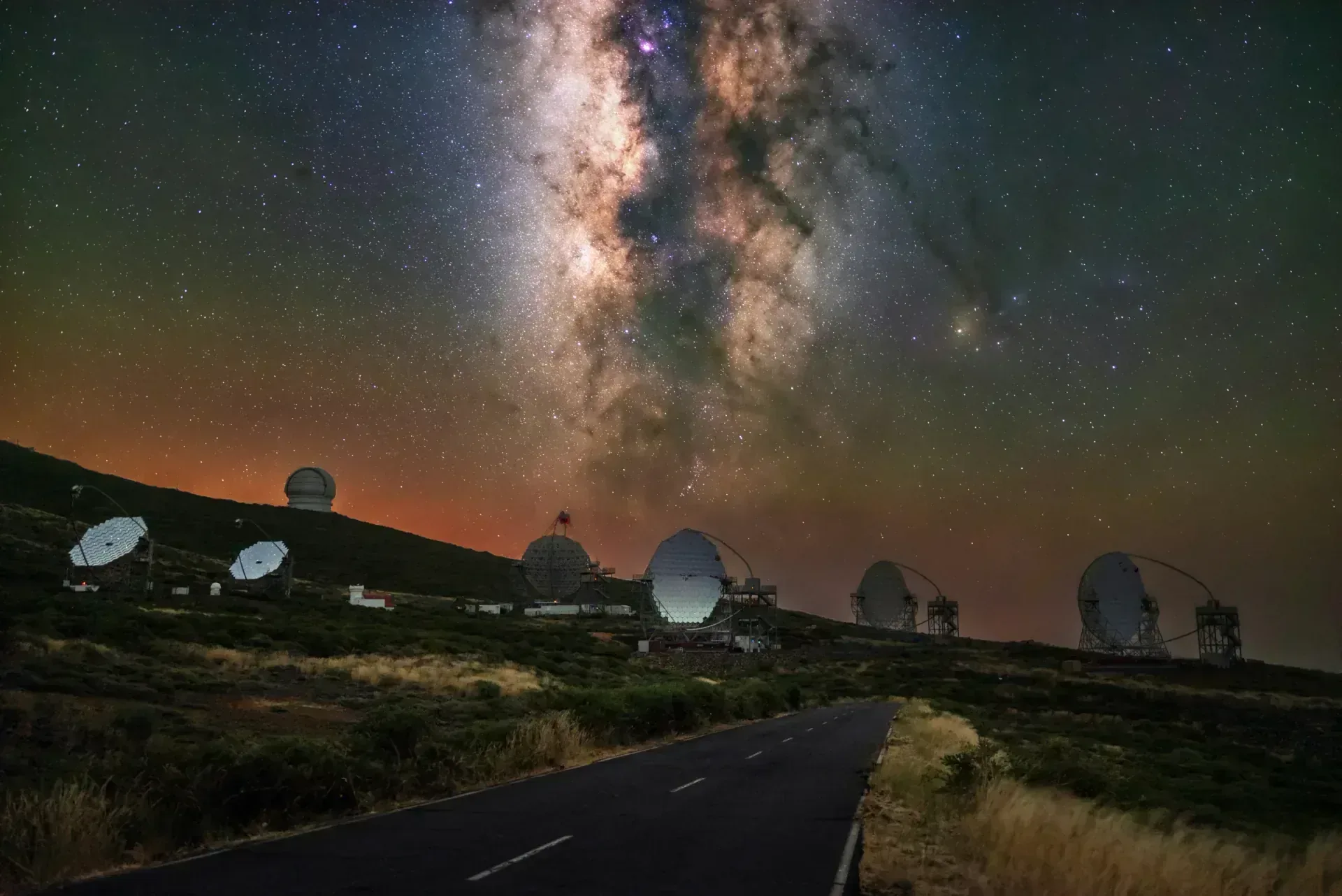
Island of
Stars
La Palma has one of the purest and darkest night skies on the planet. A volcanic island where astronomy is heritage, culture and a way of life.
2,426 m
Observatory altitude
+300
Clear nights per year
+20
World-class telescopes
1985
ORM inauguration year
Europe's purest
night sky
Did you know that La Palma is also called The Star Island? Thanks to its unique astronomical conditions of clarity and darkness, in April 2007 it was declared Starlight Tourist Destination and Starlight Reserve at the International Conference in Defence of the Quality of the Night Sky.
The westernmost volcanic island of the Canary archipelago offers more than 300 clear nights per year, an exceptionally clean atmosphere and darkness protected by law. These conditions make it one of the best places in the world for astronomical observation.
Its privileged orography, with peaks exceeding 2,400 metres, places telescopes above the clouds and far from light pollution, offering a unique window to the universe in the northern hemisphere.
Certified dark sky
Sky darkness levels of 21.9 mag/arcsec² — among the best on the planet.
Unique legal protection
The only night sky in the world protected by law since 1988.
Global science hub
Researchers from more than 20 countries work at the ORM every year.
Certified Starlight guides
Experts with official accreditation to offer you the best experience.
Real-time sky conditions
Moon phase · Weather · Webcams
Astronomical viewpoints
Network of 16 viewpoints · Interactive map
Island of Stars' Milestones
Decades of science, legislation and international recognition endorse the exceptional quality of the skies of La Palma.
Observatory inauguration
Driven by the IAC, the Roque de los Muchachos Observatory (ORM) is inaugurated at 2,426 metres of altitude in the Caldera de Taburiente National Park.
The Sky Law
La Palma becomes the only place in the world where the night sky is protected by law. Law 31/1988 regulates light, radioelectric and atmospheric pollution above the Observatory.
UNESCO Biosphere Reserve
The island is recognised as a UNESCO Biosphere Reserve, protecting its exceptional biodiversity, volcanic landscapes and unique natural environment.
World's first Starlight Reserve
The first Starlight certification is given to La Palma, which is declared a Starlight Reserve and Starlight Tourist Destination at the International Conference in Defence of the Quality of the Night Sky.
Gran Telescopio Canarias
The GTC is inaugurated with a segmented primary mirror of 10.4 metres, the largest optical-infrared telescope in the world to date. A milestone in the history of astronomy.
Global astronomical benchmark
La Palma maintains its position as one of the best destinations on the planet for astronomical observation, with over 20 active telescopes and thousands of researchers from around the world.
The Roque de los Muchachos
Observatory
One of the most important astronomical observatories in the world, installed on the summit of La Palma since 1985.
Gran Telescopio Canarias
The GTC, with a segmented primary mirror of 10.4 metres in diameter, is the largest optical-infrared telescope in the world to date.
Institute of Astrophysics
The IAC manages the ORM and coordinates research projects with institutions from more than 20 countries, a world reference in astrophysics.
International collaboration
The ORM hosts telescopes from Germany, Sweden, the Netherlands, the UK, Italy and other countries, making it a global hub for astronomical research.
Visit the observatory
Located at 2,426 metres altitude in the Caldera de Taburiente National Park, the ORM hosts more than 20 telescopes from institutions worldwide. Its exceptional conditions make it one of the best places on Earth to explore the universe.
The Sky Law
La Palma is the only place in the world where the night sky is protected by law. Law 31/1988 regulates four key aspects to preserve sky quality above the Roque de los Muchachos Observatory.
Light pollution
Public lighting installations must comply with basic standards to preserve the darkness of night and allow enjoyment of the starry sky.
Radioelectric pollution
Radiocommunication stations must operate within a maximum power flux density limit to prevent interference with the Observatory telescopes.
Atmospheric pollution
Industries and polluting activities are not permitted above 1,500 metres altitude.
Flight routes
Air traffic is regulated over the Observatory to prevent turbulence caused by aircraft.
Experience the skies of La Palma
Book an astronomical experience and discover first-hand why this sky is unique in the world.